About

Cape Foulweather Complex is a designated Marine Conservation Area
Marine Conservation Areas are sites with the goal of conserving the natural ecosystem by prohibiting the take of some or all invertebrates, and site restrictions vary by site. Cape Foulweather is designated as such to educate, monitor, and apply ecosystem-based management to conserve the ecological structure of the rocky habitat species facing effects of changing climate. There are no changes to the existing statewide harvest regulations for fish, invertebrates, or plants, except subtidal kelp harvest is now closed*.
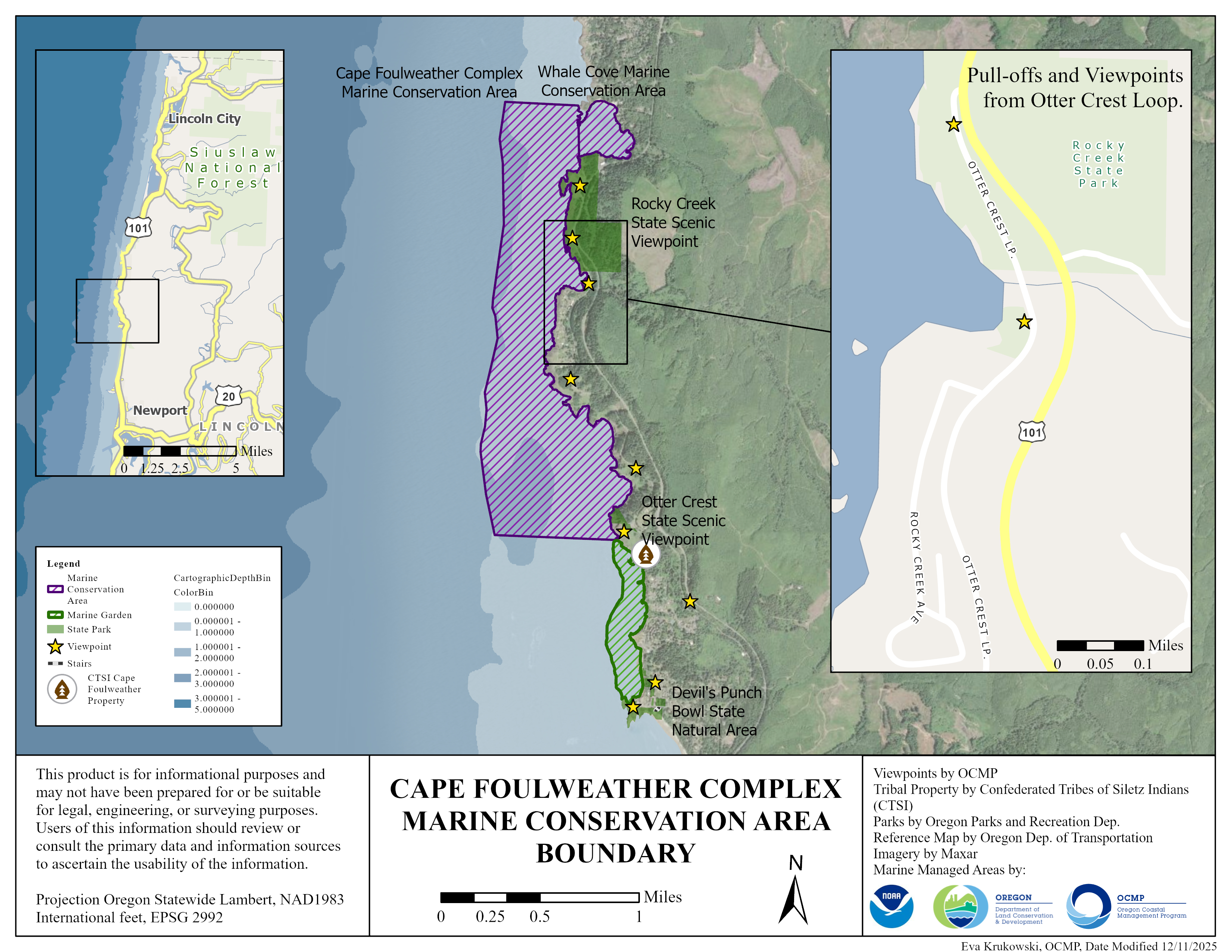
Within the Marine Conservation Area (MCA) boundary, there are 31 islands and offshore rocks that together total one acre. Due to the steep terrain, there is limited intertidal habitat. There are 587 acres of subtidal habitat within the MCA, most of it dominated by rocky substrate. The maximum depth is 72 feet. The seaward boundary of the MCA is inclusive of hard substrates, which provide habitat for canopied kelp forests.
Features
Key Resources
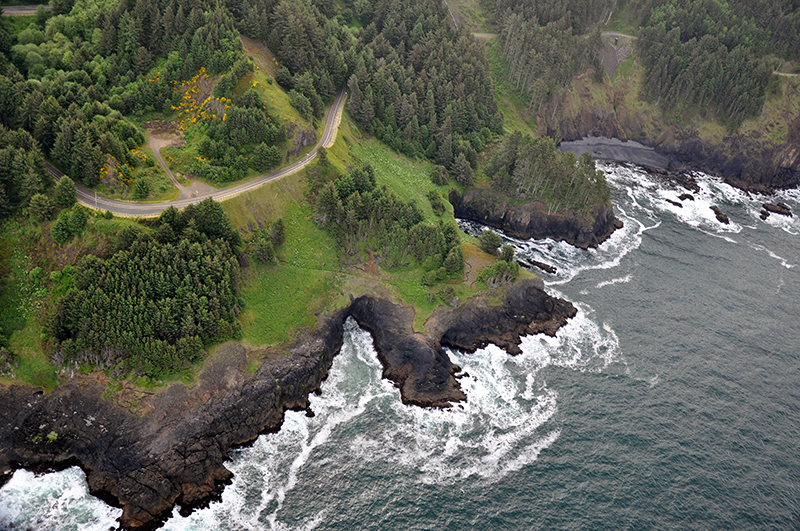
Cape Foulweather rises 500 feet above the Pacific Ocean, providing sweeping views from Yaquina Lighthouse north to Cascade Head. Gray whales cavort and feed in the kelp beds below a series of scenic viewpoints. Seabirds nest on the Cape’s sheer cliffs, and waves crash onto the rocks below. Nowhere is the wild spirit of the central Oregon coast captured better than at Cape Foulweather.
The Cape Foulweather Complex MCA includes both intertidal and subtidal rocky habitats. The intertidal habitat at the base of the cliffs and adjacent subtidal rocky reefs are home to extensive canopied bull kelp forests (spanning 75 acres) that are rich in biodiversity. These kelp forests provide gray whales with abundant food resources and serve as a nurturing habitat for Pacific coast groundfish and salmon. Pinnipeds are also common, either hauling out on the rocky shoreline or seeking refuge within the kelp, making them an integral part of the area’s diverse marine life.
The kelp forests at Cape Foulweather are the largest and most significant kelp beds along Oregon’s central and north coasts. However, these kelp forests are threatened by the exploding purple sea urchin population in the region. Purple sea urchins feed extensively on algae like bull kelp, resulting in dramatic losses of kelp forests, putting the area’s biodiversity at risk. It’s notable that the kelp forests at Cape Foulweather seem to be more resilient to the advance of purple sea urchins, along with a few other locations on the Oregon coast. Thus, they could serve as a comparison site for researchers studying sea urchin impacts.
The rocky shoreline serves as a vital nesting habitat and feeding ground for various seabird species, including large colonies of Pelagic and Brandt’s Cormorants, as well as Pigeon Guillemots and Black Oystercatchers. However, these are not the only avian species inhabiting the site. During the summer and early fall, flocks of Brown Pelicans exploit the rich kelp forests for feeding, while Bald Eagles are known to prey on nests.
Site Uses
Visitors and residents enjoy vast ocean views, whale watching and other wildlife viewing and short trails along Otter Crest Drive and at the Otter Crest State Scenic Viewpoint. Rocky Creek State Scenic Viewpoint and Rodea Point offer dramatic views. Offshore, both personal and charter recreational fishing vessels commonly target groundfish found next to and within subtidal rocky habitats, especially where kelp forests abound. Both residents and visitors fish from shore. Kayak fishing is also becoming increasingly popular.
Access
There is no direct public access to the intertidal at the Cape Foulweather Complex Marine Conservation Area. Access to scenic viewpoints of the site are along the Otter Crest Loop.
Along the Cape Foulweather Complex Marine Conservation Area eastern boundary, recreation facilities include Rocky Creek State Scenic Viewpoint, Rodea Point pullout, Rocky Creek bridge pullout, Otter Crest State Scenic Viewpoint, and the Look-Out on Cape Foulweather historic building and gift shop.
Management
Site Management
Cape Foulweather Complex was designated as a Marine Conservation Area in 2024. The original site proposal can be found here: Cape Foulweather Complex Marine Conservation Area Site Proposal, 2020.
Regulations
There are no changes to the existing statewide harvest regulations for fish, invertebrates, or plants, except subtidal kelp harvest is now closed. Follow statewide ODFW harvest rules regarding harvest of fish or invertebrates.
Ownership
Management Plan
Feedback Opportunity: Rocky Habitat Site Management Planning
The Oregon Coastal Management Program is Seeking Feedback on
Rocky Habitat Management Plans
OCMP facilitated a two-part public workshop series in 2024 and 2025 to help inform the development of area-based management plans. OCMP has finished drafting the plans following the workshops in 2024 and 2025. The Plans, informed by coastal communities, will provide a framework to support activities within Marine Conservation Areas, Marine Research Areas, and Marine Gardens near Cannon Beach, Netarts, Depoe Bay, Newport, Coquille, and Port Orford.
Public Comment Opportunity on the Site Management Plans:
Read the Draft Plans:
- Ecola Point Marine Conservation Area Management Plan
- Chapman Point Marine Garden Management Plan
- Cape Lookout Marine Conservation Area Management Plan
- Fogarty Creek Marine Conservation Area Management Plan
- Cape Foulweather Complex Marine Conservation Area Management Plan
- Blacklock Point Marine Conservation Area Management Plan
- Cape Blanco Marine Research Area Management Plan
Your feedback is important. OCMP is especially interested in feedback on:
- Chapter 2: Site Management Strategies
- Appendix H: Recommended Implementation Actions Table
Comments are due February 2, 2026
When commenting, please reference specific page numbers and section headers. You’re also welcome to suggest additional writing, graphics, images, or links that could enhance the Plan.
Email comments to: "
Mail comments to: ATTN: Andy Lanier, OCMP-DLCD, 635 Capitol St. NE, Suite 150, Salem, OR 97301-2540.
Please reach out to Andy Lanier, the Marine Affairs Coordinator with any questions, comments, or to request more information,